Wedding Ceremony Script: A Complete Template You Can Copy
A complete wedding ceremony script in the traditional order, with word-for-word wording for the officiant, a 5-minute short version, religious and non-religious variations, and tips for first-time officiants.
By The Okerly team 16 min read
On this page
The ceremony is the shortest part of the wedding day and the one everyone remembers. In about twenty minutes, two people make promises in front of the people they love most, and somebody has to know exactly what to say, in what order, and when to hand over the rings. That is what a wedding ceremony script is for.
Below you'll find a complete wedding ceremony script you can copy and adapt: every part in the traditional order, word-for-word wording for the officiant, notes on who does what, a short five-minute version for elopements and small weddings, and practical tips for anyone officiating for the first time. Replace the words in [brackets] with your own details, cut what doesn't feel like you, and keep what does.
What is a wedding ceremony script?
A wedding ceremony script is the written running order of the ceremony, from the moment the music starts until the couple walks back down the aisle. It includes everything the officiant says, the cues for the musicians and the wedding party, the readings, the vows and the ring exchange, and the legal words that make the marriage official.
Most scripts are written by the officiant together with the couple. A religious leader usually brings a set liturgy and leaves room for a few personal touches. A professional celebrant or a friend who got ordained for the day will usually start from a template like the one below and build the personal parts around the couple's story.
The wedding ceremony order at a glance
Ceremonies vary between cultures and faiths, but most Western weddings, religious or not, follow the same basic shape. Here is the order this script uses, with a rough idea of how long each part takes.
| # | Part of the ceremony | Who leads it | Approx. time |
|---|---|---|---|
| 1 | Processional | Wedding party, music | 3–5 min |
| 2 | Welcome and opening words | Officiant | 2 min |
| 3 | Acknowledging family and loved ones | Officiant | 1 min |
| 4 | Reading | Guest reader or officiant | 2–3 min |
| 5 | The couple's story | Officiant | 3–4 min |
| 6 | Declaration of intent (the "I dos") | Officiant and couple | 1 min |
| 7 | Exchange of vows | Couple | 2–4 min |
| 8 | Ring exchange | Couple | 1–2 min |
| 9 | Unity ritual (optional) | Couple | 2–3 min |
| 10 | Closing words | Officiant | 1 min |
| 11 | Pronouncement and kiss | Officiant and couple | under 1 min |
| 12 | Presentation of the couple | Officiant | under 1 min |
| 13 | Recessional and announcements | Couple, wedding party, officiant | 2 min |
Some couples sign the marriage license during the ceremony, just before the pronouncement or right after the recessional, rather than privately with the officiant and witnesses. Put it wherever it feels natural and add a line for it in your script so nobody is left wondering when it happens.
How long should a wedding ceremony script be?
Most ceremonies last 20 to 30 minutes, and a ceremony that runs much longer starts to lose guests standing in the sun or sitting on folding chairs. People speak at roughly 120 to 140 words a minute when they read aloud slowly and clearly, which is how you should read at a wedding. The officiant's part of a 20-minute ceremony is usually 1,500 to 2,000 words. The rest of the time goes to music, the processional, readings and the vows.
If your draft is much longer than that, trim the welcome and the closing words first. The couple's story, the vows and the ring exchange are the parts guests actually come for.
Full wedding ceremony script (template)
This is a modern, non-religious script that works for most couples, and it's easy to make more spiritual (see the variations further down). Spoken lines are in quotation marks, stage directions are in italics, and everything in [brackets] is yours to replace. We use [Partner 1] and [Partner 2] throughout. Swap in first names, and decide in advance who goes first in each part.
1. Processional
Guests are seated. The music changes to signal the start, and everyone in the ceremony enters in an order agreed at the rehearsal.
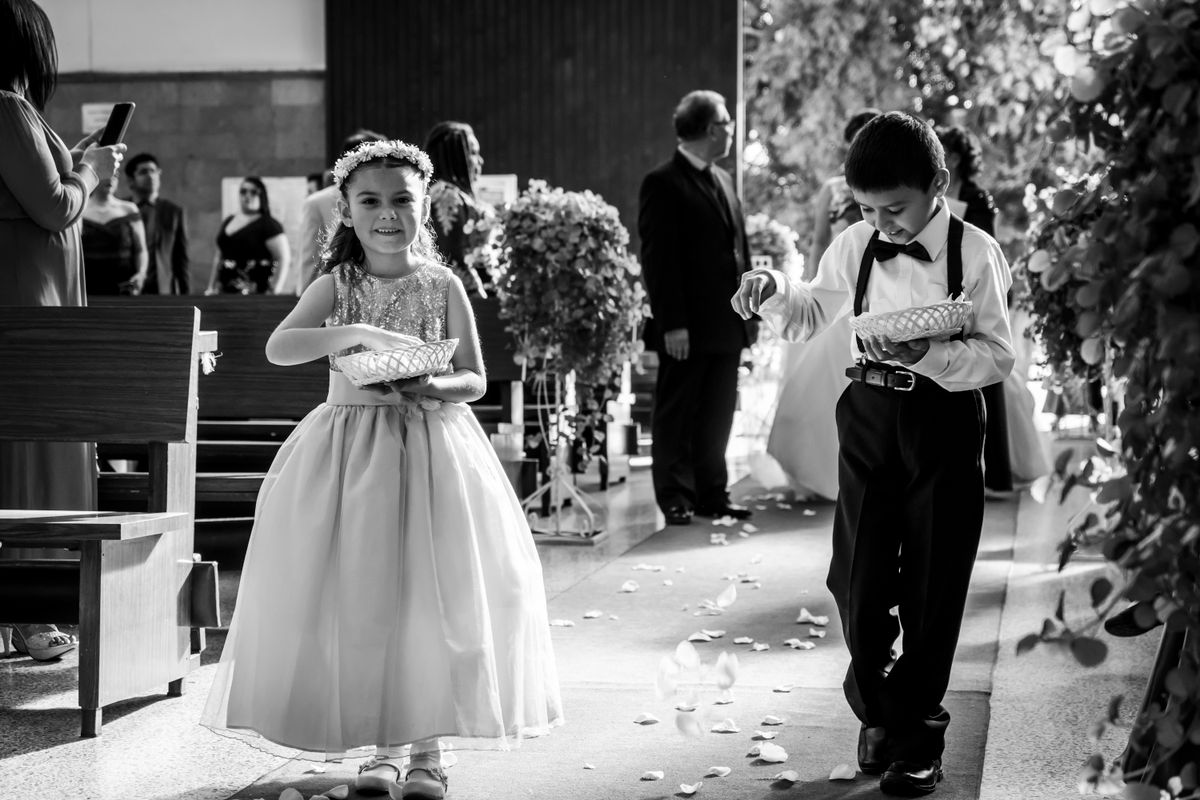
A common processional order is: the officiant; [Partner 1], escorted by parents or walking alone; the grandparents and parents, if they are not escorting anyone; the attendants, one at a time or in pairs; the maid or man of honor and the best man or best woman; the ring bearer and the flower girl; and finally [Partner 2], escorted or alone. Many couples now walk in together or each with both parents, so treat this as a starting point, not a rule.
When [Partner 2] reaches the front, the officiant invites the guests to sit if they stood up.
Officiant: "Please be seated."
2. Welcome and opening words
Officiant: "Good afternoon, everyone, and welcome. My name is [Officiant's name], and it is my honor to stand here with [Partner 1] and [Partner 2] today. On behalf of both of them, thank you for being here. Some of you have traveled a long way, and all of you have played a part in the story that brought them to this moment."
"We are here to celebrate love, and to witness [Partner 1] and [Partner 2] promise to share their lives with each other. Marriage is not something that happens in a single afternoon. It is built, day by day, in small choices: patience on a hard day, kindness when nobody is watching, and the decision to keep choosing each other. Today is where they say that out loud, in front of the people who matter most to them."
Tip: this is the place for one or two sentences about what marriage means to this couple. Keep it short; the personal story comes later.
3. Acknowledging family and loved ones
Officiant: "[Partner 1] and [Partner 2] want to thank their parents, [names], for their love and support, and for everything they have done to bring them here. They also want to remember those who cannot be with us today, especially [names]. Their love is part of this day, and we carry them with us."
Tip: check with the couple before naming anyone who has passed away. A short, warm line works better than a long tribute, which can be hard for some family members to sit through.
4. Reading
Officiant: "[Partner 1] and [Partner 2] have asked [Reader's name], [relationship to the couple], to share a reading with us."
The reader comes forward, reads, and returns to their seat. If there is no guest reader, the officiant reads it.
Popular choices include a passage from The Velveteen Rabbit, E. E. Cummings' "i carry your heart with me", Pablo Neruda's Sonnet XVII, an extract from Captain Corelli's Mandolin by Louis de Bernières, and 1 Corinthians 13 ("Love is patient, love is kind") for a religious or traditional ceremony. One reading is plenty for a short ceremony, and few ceremonies need more than two.
5. The couple's story
This is the heart of a personal ceremony and the part guests talk about afterwards. Aim for three to four minutes: how the couple met, a moment that shows who they are together, and what their friends and family see in them.
Officiant: "[Partner 1] and [Partner 2] met [where and how]. [Partner 1] remembers [a detail]. [Partner 2] remembers it a little differently: [a funny or tender detail]."
"Over the last [number] years, they have [shared adventures, challenges, a move, a pet, a family]. When I asked [Partner 2] what they love most about [Partner 1], they said [answer]. When I asked [Partner 1] the same question, they said [answer]. And when I asked the people who know them best, the word I heard again and again was [word]."
"[Partner 1] and [Partner 2], what you have built together is the reason we are all here. Today you make it a promise."
Tip: ask each partner to answer the same five or six questions separately, without seeing each other's answers. The differences make the best material. A list of questions is further down.
6. Declaration of intent (the "I dos")
The declaration of intent is the moment each partner confirms, out loud, that they are marrying freely and willingly. In many places it is part of what makes the marriage legal, so don't skip it.
Officiant: "[Partner 1], do you take [Partner 2] to be your [wife / husband / partner], to love, honor and cherish, in good times and in bad, for as long as you both shall live?"
Partner 1: "I do."
Officiant: "[Partner 2], do you take [Partner 1] to be your [wife / husband / partner], to love, honor and cherish, in good times and in bad, for as long as you both shall live?"
Partner 2: "I do."
Optional: some couples ask the guests to promise their support too. "Will all of you, their family and friends, support and love [Partner 1] and [Partner 2] in their marriage? If so, please answer 'We will!'"
7. Exchange of vows
Officiant: "[Partner 1] and [Partner 2] will now share the promises they have made to each other. [Partner 1], please take [Partner 2]'s hands."
Traditional vows, repeated after the officiant in short phrases:
"I, [Partner 1], take you, [Partner 2], to be my [wife / husband / partner], to have and to hold from this day forward, for better, for worse, for richer, for poorer, in sickness and in health, to love and to cherish, for as long as we both shall live."
The officiant repeats the same vows for [Partner 2].
Modern vows, repeated after the officiant:
"[Partner 2], I choose you today, and I promise to keep choosing you. I promise to be your partner in every adventure, to laugh with you, to listen to you, and to stand by you when life is hard. I will respect who you are and support who you are becoming. Everything I am is yours, today and every day."
If the couple wrote their own vows, the officiant simply says: "[Partner 1] and [Partner 2] have written their own vows. [Partner 1], whenever you're ready." Keep personal vows to about one minute each, and have the officiant hold a printed copy in case nerves win.
8. Ring exchange
Officiant: "The ring is a circle, with no beginning and no end. It is a symbol of a love that is whole and lasting. May I have the rings, please?"
The best man, maid of honor or ring bearer hands the rings to the officiant, who gives one to each partner.
Officiant: "[Partner 1], please place the ring on [Partner 2]'s finger and repeat after me."
Partner 1: "[Partner 2], I give you this ring as a symbol of my love and faithfulness. With this ring, I thee wed."
Officiant: "[Partner 2], please place the ring on [Partner 1]'s finger and repeat after me."
Partner 2: "[Partner 1], I give you this ring as a symbol of my love and faithfulness. With this ring, I thee wed."
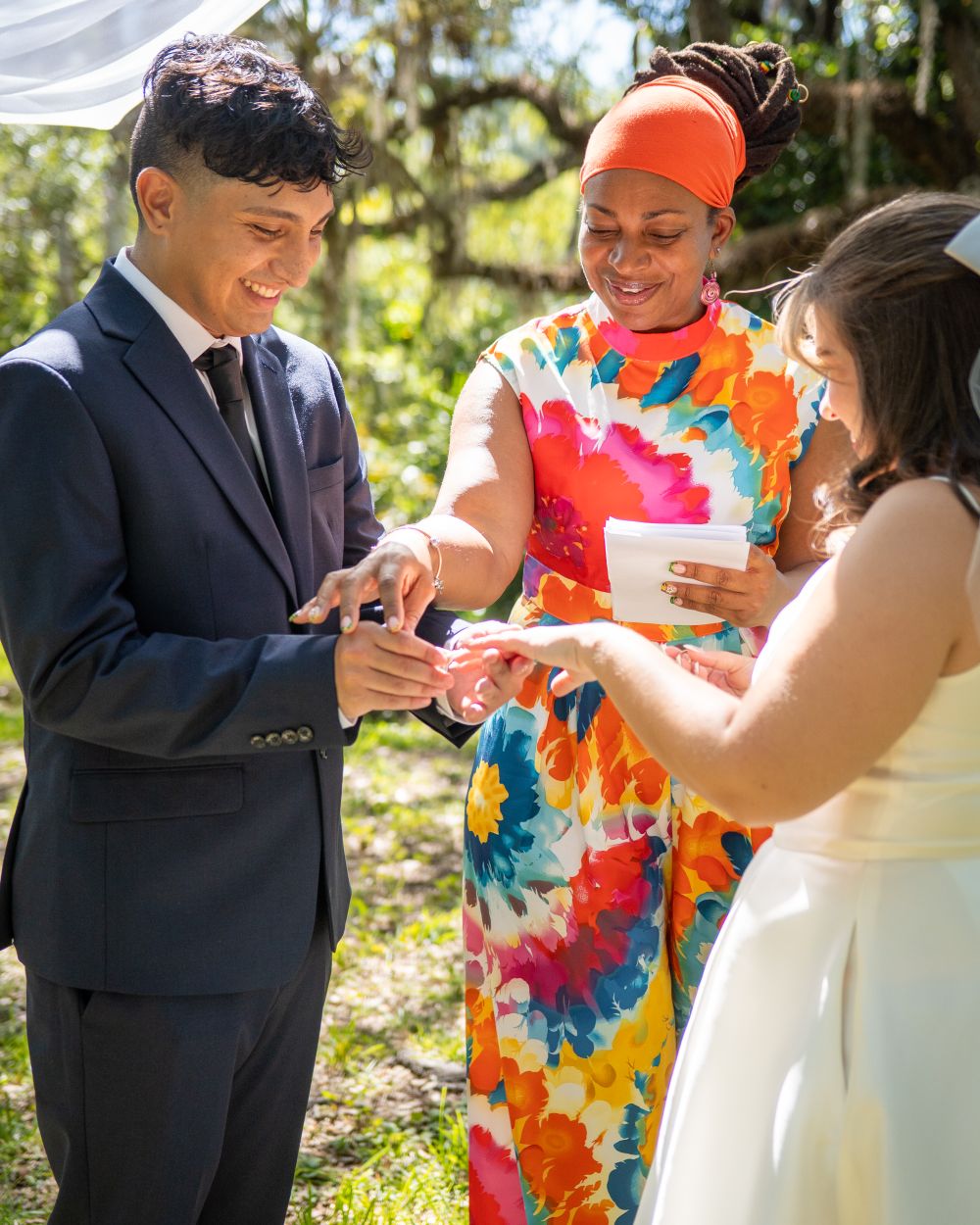
Tip: the officiant should put the rings in a pocket, not hold them in an open hand. Rings dropped on a wooden deck roll a surprisingly long way.
9. Unity ritual (optional)
A unity ritual is a small symbolic act that shows two lives becoming one. Popular choices are a unity candle, pouring two colors of sand into one vase, handfasting (tying the couple's hands with a cord or ribbon), planting a tree, or a wine ceremony with a shared cup.
Officiant (sand ceremony): "[Partner 1] and [Partner 2] will now pour their two colors of sand into a single vase. Just as these grains can never be separated again, their lives are now joined together."
Play soft music during the ritual, and keep it under three minutes.
10. Closing words
Officiant: "[Partner 1] and [Partner 2], may your home be a place of laughter and rest. May you be patient with each other, quick to forgive and slow to anger. May you keep the curiosity you have for each other today, and may the love you feel right now carry you through every season ahead."
11. Pronouncement and kiss
Officiant: "[Partner 1] and [Partner 2], you have made your promises to each other in front of all of us. And so, by the power vested in me by [the State of / the laws of] [place], it is my absolute joy to pronounce you married. You may kiss!"
The couple kisses. Guests cheer.
The exact legal wording varies. Some places require a specific phrase, and a religious officiant may pronounce the couple married "in the presence of God". If you are officiating, check the requirements where the wedding takes place before you finalize this line.
12. Presentation of the couple
Officiant: "Family and friends, it is my honor to present to you, for the very first time, [the newlyweds / Mr. and Mrs. / Mr. and Mr. / Mrs. and Mrs.] [names]!"
Ask the couple in advance exactly how they want to be introduced, including whether either of them is changing their name.
13. Recessional and announcements
The recessional music starts. The couple walks back up the aisle first, followed by the wedding party in reverse order, then the parents and grandparents.
Officiant: "Thank you all for being part of this beautiful ceremony. [Partner 1] and [Partner 2] invite you to join them for drinks [on the terrace / in the garden], and dinner will be served at [time]. Please stay seated for a moment while the family leaves first."
Short and simple wedding ceremony script (about 5 minutes)
For an elopement, a courthouse-style wedding or a small ceremony at home, this short script covers everything that matters, including the declaration of intent and the pronouncement.
Officiant: "Welcome. We are here to celebrate the marriage of [Partner 1] and [Partner 2], and to witness the promises they make to each other today."
"[Partner 1], do you take [Partner 2] to be your [wife / husband / partner], to love and to cherish, from this day forward?"
Partner 1: "I do."
Officiant: "[Partner 2], do you take [Partner 1] to be your [wife / husband / partner], to love and to cherish, from this day forward?"
Partner 2: "I do."
Officiant: "Please face each other and share your vows."
The couple says their vows, written or repeated after the officiant.
Officiant: "May I have the rings? [Partner 1], please place this ring on [Partner 2]'s finger and say: 'With this ring, I marry you.'" Repeat for [Partner 2].
"By the power vested in me by [place], I now pronounce you married. You may kiss!"
That's it: five minutes, every legal and emotional essential included. Add a short reading or a few lines about the couple if you have a little more time.
How to change the tone of the script
The structure stays the same whatever style you choose. What changes is the wording of the welcome, the reading, the closing words and the pronouncement.
Religious or spiritual ceremony
Open with a prayer or blessing instead of the general welcome, choose a scripture reading, and end with a blessing for the marriage. For example: "May God bless you and keep you, may your love be patient and kind, and may your home be filled with His peace." If your ceremony is led by a priest, minister, rabbi or imam, they will usually provide the core wording and tell you where personal elements can go.
Non-religious ceremony
Non-religious ceremonies speak of commitment, community and the couple's own values rather than faith. Choose readings from poetry, novels or song lyrics, and use the closing words to wish the couple well rather than to bless them. The template above is already non-religious, so you can use it as it is.
Lighthearted or funny ceremony
Humor works best in the couple's story and in the welcome, never in the vows or the declaration of intent. A gentle joke about how the couple met, a ritual like a wine box or a "rules of the house" moment, or a line such as "[Partner 1] promises to stop pretending they've watched the episode already" will get a laugh without undermining the moment. Keep in-jokes to a minimum. If only three guests understand it, cut it.
How to write your own wedding ceremony script
- Agree on the essentials first. Length, tone (religious, spiritual or not), languages, readings, rituals, and anything that must or must not be mentioned.
- Check the legal requirements. Ask the local registrar or county clerk what the officiant has to say and do, who must sign the license, and how many witnesses you need.
- Send each partner the same questions. Ask them to answer separately: How did you meet? When did you know? What do you love most about each other? What's a moment you'll never forget together? What do you argue about, lightly? What does marriage mean to you?
- Write the couple's story from the answers. Pick one or two specific moments rather than summarizing their entire relationship.
- Fill in the template. Start from the order above, then cut anything that feels like filler.
- Read it out loud and time it. Then cut 10 percent. Every script gets better shorter.
- Share the final version. Send the final running order to the musicians, the photographer and the coordinator so they know every cue.
Tips for first-time officiants
- Print the script in large type and put it in a plain black folder. A phone screen goes dark, reflects the sun and looks bad in photos.
- Mark the cues in bold: when the music starts, when to ask for the rings, when to step aside for the kiss.
- Step aside for the kiss. Move a step to the side just before the pronouncement, so the photographer doesn't capture you between the couple.
- Use a microphone if there are more than about 40 guests or you're outdoors. Speak more slowly than feels natural.
- Run the whole ceremony at the rehearsal, including the processional order and who holds the rings.
- Bring the paperwork. Know who has the marriage license, sign it right after the ceremony, and return it within the deadline.
- Remind guests about phones. If the couple wants an unplugged ceremony, say so in your welcome: "[Partner 1] and [Partner 2] invite you to be fully present with them. Please put your phones away. The photographer has it covered."
Wedding ceremony script FAQ
Who writes the wedding ceremony script?
Usually the officiant, working with the couple. Professional officiants and celebrants often send a questionnaire and draft the script themselves. When a friend officiates, the couple and the friend typically write it together from a template like the one above.
What order do the vows and rings go in?
The declaration of intent ("I do") comes first, then the vows, then the ring exchange. The rings symbolize the promises you've just made, which is why they come after the vows.
Do we need a reading in our ceremony?
No. Readings are a lovely way to involve a family member or friend and to set the tone, but they're optional. A short ceremony without a reading is perfectly complete.
What does the officiant say to start the ceremony?
Something simple that welcomes the guests and names the occasion, such as: "Good afternoon, and welcome. We are gathered here today to celebrate the marriage of [Partner 1] and [Partner 2]." Then the officiant introduces themselves if many guests won't know them.
What does the officiant say at the end of the ceremony?
After the pronouncement and the kiss, the officiant presents the couple ("It is my honor to present to you, for the first time, the newlyweds!"), then shares any practical announcements about where guests should go next.
Can a friend officiate our wedding?
In many places, yes. In most US states a friend can officiate after getting ordained online, but the rules vary by state and sometimes by county, and in many other countries the legal part must be performed by a registrar or civil officer. If that's your case, a friend can still lead a symbolic ceremony, using this same script, after the legal formalities.
A good ceremony doesn't need fancy words. It needs a clear order, a few honest sentences about the couple, and promises said out loud. Start from this script, make it yours, and read it through at least twice before the day. Your guests will remember how it felt, and the couple will remember every word.